

How Can Data and Reporting Improve Your Uniform Program?
Ask most operations leaders how their uniform program is performing and you will get an impression, not an answer. Employees seem happy enough. Costs feel roughly in line with last year. Nobody has complained loudly lately.
That is the level most uniform programs are managed at: on impression rather than information. The data that would tell a clearer story is usually scattered across supplier invoices, email requests, and whatever a manager remembers from the last few months. A program that touches hiring, brand image, safety compliance, and recurring cost every year deserves the same reporting rigor as any other significant line item.
What Reporting Actually Reveals
When ordering, sizing, and reorder data are tracked centrally instead of scattered across invoices and inboxes, a few things become visible almost immediately:
- Cost per employee by location, which often reveals one site spending noticeably more than another for no operational reason.
- Reorder frequency by item, a signal that usually points to a fabric or fit issue rather than normal wear.
- Turnover-related reissues, showing how many uniforms go out because of staff turnover rather than damage or growth.
None of this requires guesswork once the data exists. It requires someone actually looking at it, which most programs skip simply because the numbers were never gathered into a report anyone could review.
From Reactive Purchasing to Planned Purchasing
Without reporting, uniform purchasing tends to be reactive. An item runs low, someone notices, and an order goes out under time pressure, often at a less favorable price or shipping timeline.
With historical ordering data in hand, purchasing can shift to a planned cycle instead. A company that always sees a spike in requests each September can place that order in July rather than scrambling in August. The same data supports budgeting conversations that used to run on rough estimates. A finance team asking what the program costs per employee, per location, or per year can get an actual number instead of a guess based on last year’s invoice total.
Using Reporting to Catch Problems Early
Reporting is a quality control tool, not just a cost tool. A spike in reorders for a specific size range can mean the size chart itself is off. A location placing unusually frequent requests might have a manager who is not enforcing standards, or a durability issue tied to that site’s working conditions. These patterns are nearly impossible to spot without data, and easy to miss when every location is managed with no shared view.
What Reporting Looks Like Inside a Managed Program
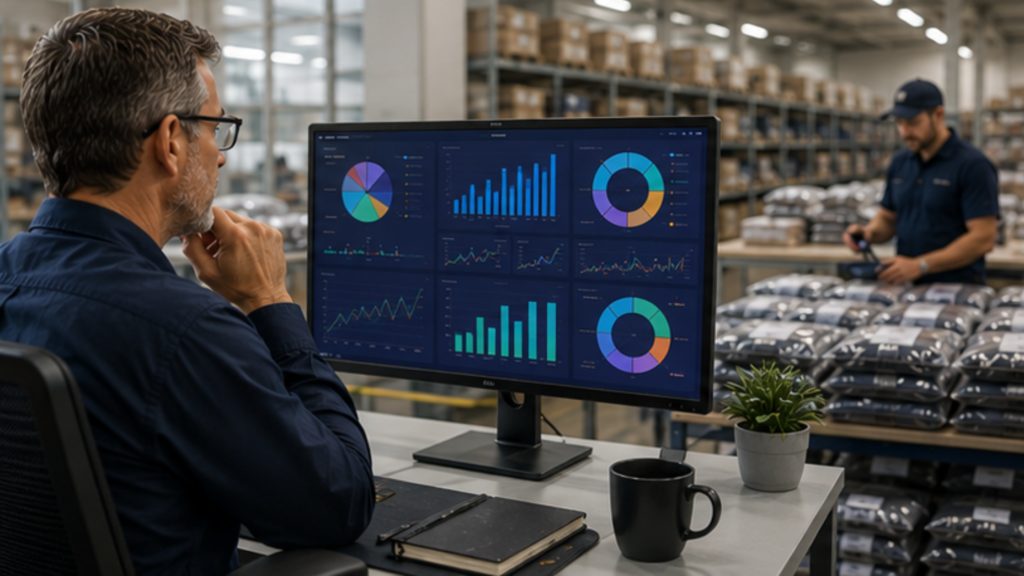
The Proximity System™, Unitec’s proprietary platform, builds this visibility in rather than leaving it as a side project. Admins get real-time tracking across order history, usage trends, and spend, with the ability to drill down by department, role, or employee from one dashboard. That replaces quarterly guesswork with an ongoing, current view.
This is one piece of how Unitec’s managed uniform program works end to end, alongside role-based ordering, in-house customization, and zero-sort distribution. A dedicated account representative also reviews program activity with admins, so reporting is not just a dashboard nobody opens.
Frequently Asked Questions
What can reporting show that a supplier invoice cannot? Line-item invoices show what was billed. Program-level reporting shows patterns across time, location, and role, such as which sizes are reordered most, which locations are overspending, and how much turnover is driving reissues.
Do we need new software to get this kind of reporting, or can we build it from existing data? Most companies could technically build it from invoices and order emails, but in practice the data stays too scattered to be useful. A platform that centralizes ordering and reporting from the start removes that manual assembly work.
Is reporting only useful for large organizations? No. Organizations from about 100 up to 5,000 or more uniformed employees benefit from having ordering data in one place, since even a modest program can carry unnoticed cost and sizing problems.
See What Your Data Would Show
A uniform program without reporting can still function, but it functions the way a business runs without checking its numbers: well enough until it is not. Take the free Uniform Program Scorecard to see where your current setup stands, or schedule a 15-minute consultation to see what real-time reporting would look like for your program.
Disclaimer: This content is for general informational purposes only. Program outcomes vary by organization and are not guaranteed.
Tags: uniform program reporting, The Proximity System, managed uniform program, uniform cost control, uniform ordering data, uniform program management