
Can AI Reduce Uniform Waste Without Reducing Employee Choice?
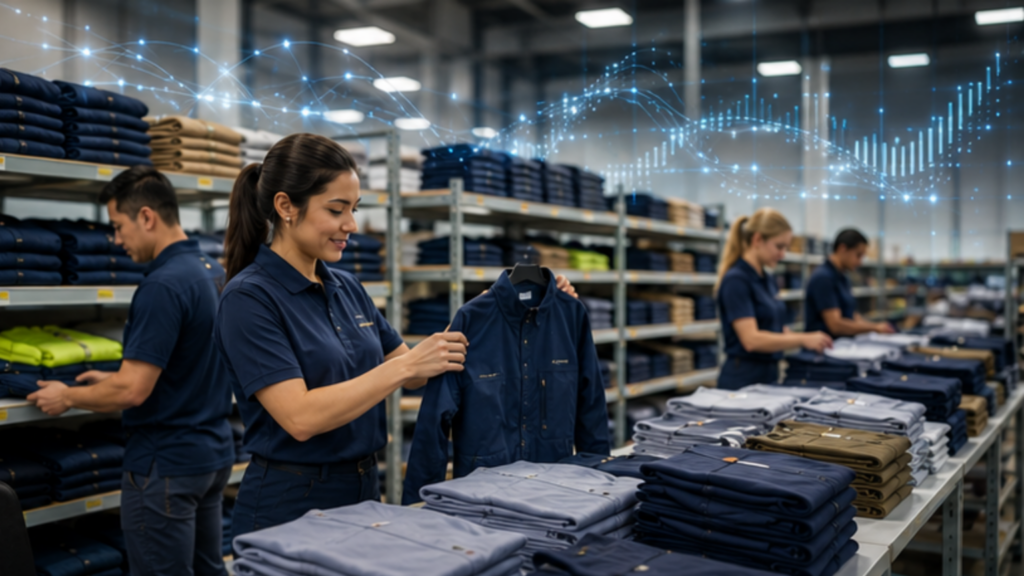
Uniform waste rarely shows up on a budget line by itself. It hides inside oversized orders, unused inventory sitting in a storage closet, and garments thrown out because a size guess was wrong.
Companies trying to fix this usually reach for one of two blunt tools. Either they narrow the options employees can choose from, which cuts fabric use but frustrates staff, or they keep ordering generously to avoid complaints, which keeps waste high. Data-driven ordering is starting to offer a third option: waste can go down because ordering gets smarter, not because choice gets smaller.
Why Uniform Waste Happens in the First Place
Most waste in a uniform program traces back to a forecasting problem, not a design problem. A company orders based on rough headcount estimates or a generic size chart, and actual need turns out to be different.
A few patterns show up again and again:
- Standard size charts rarely reflect the real size distribution of an actual workforce, which is why gender-specific fits and extended sizing matter as much as quantity.
- Turnover leaves uniforms behind in sizes the next hire does not need.
- Without visibility into what is actually being ordered, warehouses keep restocking items nobody is requesting anymore.
None of this is really about employees wanting too many choices. It is about the ordering process not having enough information to match supply to demand.
Where Data Changes the Math
Real-time order data can process history, turnover patterns, and seasonal demand far faster than a person reviewing spreadsheets once a quarter. A platform like The Proximity System™ that tracks actual sizing and reorder activity across a workforce can support smarter decisions about what to stock next, instead of ordering a flat quantity and hoping it works out.
This kind of visibility can also help flag slow-moving items before they become dead stock. If a particular size has not been ordered in months, that pattern is worth a look rather than letting it quietly keep getting restocked out of habit. Unitec published a closer look at how artificial intelligence is starting to support this kind of decision making in its AI white paper, a useful read for teams weighing where this technology actually helps in a uniform program versus where it is still more promise than practice.
Employee Choice Is Not the Enemy of Sustainability
Limiting options is an easy way to appear sustainable, but it often shifts the cost onto employee satisfaction instead of the environment. Someone who cannot get a uniform that fits well is more likely to request a replacement sooner or wear it less carefully, both of which create their own downstream waste.
A better approach lets employees choose from an appropriately sized range of approved items, using role-based eligibility and allowances so the range stays controlled, while ordering data in the background helps that range get stocked accurately. Choice and lower waste are not on opposite ends of a scale. The tension mostly shows up when ordering is reactive instead of informed by real data.
Unitec also offers sustainable uniform options sourced from ethical partners for organizations that want to build eco-friendly apparel into their program without narrowing what employees can choose from.
What This Can Look Like in Practice
A managed uniform program built around real-time data can support a few concrete outcomes:
- Reorder patterns that are visible by department, role, or location, not just guessed at once a year.
- Sizing decisions for new hires informed by actual workforce data rather than a generic chart.
- Early visibility into garments being replaced unusually often, which can point to a fit or durability issue worth addressing at the source.
Each of these can help reduce waste at a different point in the supply chain, and none of them requires telling an employee they have fewer options than they did last year.
Frequently Asked Questions
Does using data to cut uniform waste mean employees get fewer choices? Not necessarily. The goal is matching supply to actual need, not narrowing the catalog. Role-based eligibility and allowances keep ordering controlled while employees still choose from an appropriate range.
How is this different from just ordering less? Ordering less without data usually just shifts the problem, either to stockouts or to employees improvising with unapproved items. Informed ordering targets the actual mismatch between what is stocked and what is needed.
Is AI already part of Unitec’s uniform program platform? The Proximity System™, Unitec’s proprietary platform, provides real-time tracking and reporting today. Unitec’s white paper on AI’s role in uniform programs looks at where predictive technology is heading in this space.
See Where the Waste Is Hiding in Your Program
If reducing waste in your program matters to you without asking your team to sacrifice fit or preference, download Unitec’s AI white paper or take the free Uniform Program Scorecard to see where your current setup is creating waste.
Disclaimer: This content is for general informational purposes only. Results from data-driven ordering vary by organization and are not guaranteed.
Tags: AI uniform program, uniform waste reduction, sustainable uniforms, managed uniform program, uniform ordering data, employee uniform choice