
Why Does Uniform Fit Matter Across a Diverse Workforce?
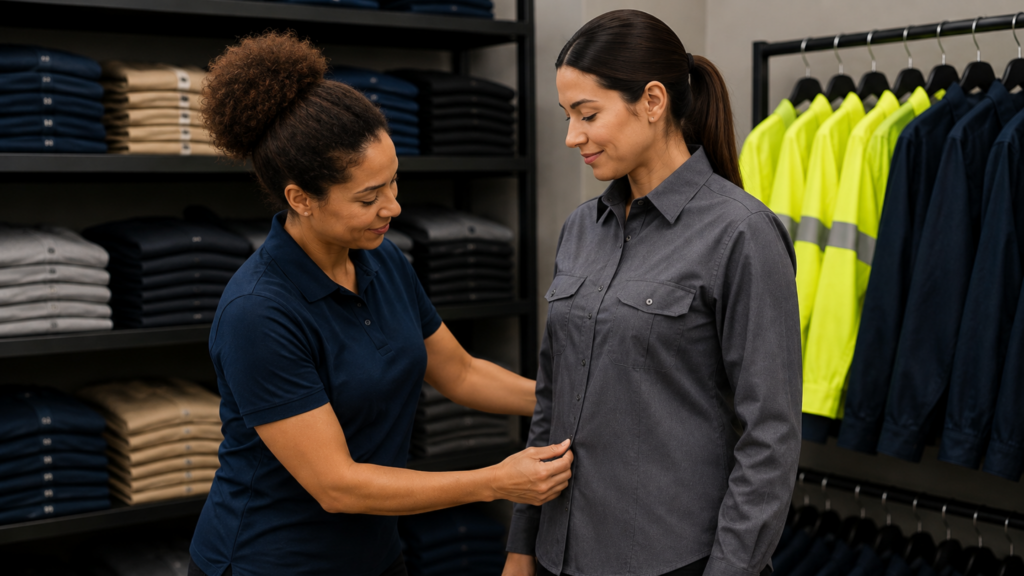
The real cost of poor uniform fit usually shows up first in onboarding, not on a safety report. A new hire who does not fit the standard sizing run for their role can wait days or even weeks for something they can actually wear, while a colleague who started the same day walks in fully outfitted. That gap is not cosmetic. It is the difference between uniforms people wear correctly from day one and uniforms people alter, avoid, or complain about.
A managed uniform program built around the right fit for every body prevents that gap from becoming a repeated onboarding problem. Here is what typically goes wrong, and what to look for in a program built to keep up with your team.
What Happens When a New Hire Does Not Fit the Standard Sizing Run
Most uniform catalogs are built around whoever made up the workforce at the time a program started. If a role or department was historically staffed by one gender or body type, the sizing options usually reflect that, sometimes without anyone deciding it that way on purpose.
The gap shows up the moment that assumption changes. Take a new hire outside the original workforce profile, for example the first woman hired into a role that has always been filled by men. She often finds the catalog does not have an item built for her, so a supervisor or admin improvises with the closest available men’s size while a real option gets sourced. That delay is the actual cost, a new hire spending their first days or weeks in something that does not fit, instead of being outfitted correctly on day one.
The Right Fit for Every Body Is the Fix, Not an Exception
Extended and gender specific sizing across every category, not just a handful of items, is what closes this gap at the source instead of solving it one new hire at a time. When the right fit for every body is built into the catalog from the start, a new employee sees options suited to them immediately, the same as anyone else on the team.
Fit affects more than how quickly someone gets outfitted. An employee wearing a uniform that is clearly too large does not present the same image as a colleague in a properly sized version of the same garment, which can affect team consistency and how prepared someone feels in their role. In some jobs, fit can support safety too, since loose fabric around cuffs or hems can catch on machinery or equipment, so getting it right protects more than appearance.
Why This Gap Is Common, and Hard to Fix Quickly
Most uniform programs are built once, around the team in place at signing, and are not revisited until a contract renews or a problem forces the issue. Sourcing and RFP processes often evaluate vendors on price per item, not on how easily a catalog can expand later as a workforce changes.
The result is that many procurement and HR teams do not discover a fit gap until a new employee is already on the job, and the closest available option is a men’s size worn by a woman, or the reverse.
How a Managed Program Adapts as a Workforce Changes
Because a managed uniform program runs on The Proximity System™ rather than a fixed printed catalog, new items and sizing options can be added as a workforce changes, without a new bid or contract.
One Unitec client’s original uniform program reflected a workforce that had always been made up of men in that particular role. When the company hired its first woman into that position, the existing catalog did not have equivalent items for her, and the team improvised with a men’s size in the meantime. Rather than treat it as a one time exception, the client asked Unitec to source a women’s alternative for every item in the catalog, so the next employee in that role would already have the right option waiting, regardless of gender. That kind of change happens inside the platform, not through a new contract.
What To Look For in a Uniform Program Built for Your Whole Team
- Gender specific sizing across every category, not only a handful of items.
- Extended sizing available as a standard option, not a special request.
- A catalog structure that can be updated as roles or demographics change, not only at contract renewal.
- A process for adding new items that does not require a new bid or contract.
- Allowance and entitlement structures flexible enough to account for individual fit needs, not only a flat per person budget.
Unitec’s own frequently asked questions page addresses this directly, in the section on how uniform options are selected to fit an entire team.
Frequently Asked Questions
Does uniform fit really affect workplace safety? Yes. Loose or oversized uniform items can catch on machinery, tools, or moving equipment, and pants or jackets that do not match an employee’s proportions can restrict movement. Fit is part of a safe uniform program, not only its appearance.
What if our workforce does not need gender specific sizing right now? Workforces change. A program that can add gender specific items or extended sizing when the need comes up, without a new contract, protects you from the exact gap this article describes as your team grows or changes.
Can a uniform catalog really be updated without renegotiating a contract? Yes, when the program runs on software instead of a fixed printed catalog. The items and sizing options live in the platform, so they can be added or changed as your workforce changes, without a new contract.
Who decides which items get added to our catalog? You do. A managed program works from your role based allowances and adds the items your team actually needs, rather than a generic list built for someone else’s workforce.
Build a Uniform Program Around the Right Fit for Every Body
If new hires are waiting on sizing, or your catalog has not been looked at since your workforce looked different than it does today, that is worth a closer look now. Take the Uniform Program Scorecard to see how your current program measures up, including how well it handles fit and sizing across your team.
Disclaimer: This content is for general informational purposes only. The client example described is anonymized and does not identify any specific organization or individual.
Tags: uniform fit, extended sizing, gender specific sizing, The Proximity System, managed uniform program, uniform program management